
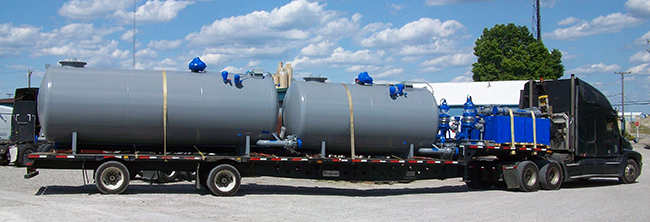
Planning heavy haul transportation for pressure vessels, boilers, process equipment, and other large industrial vessels.
Pressure vessel transport can involve large dimensions, concentrated weight, unusual shapes, lifting requirements, limited ground clearance, and strict access conditions at the origin or destination. A transportation plan should begin with the exact shipping configuration of the vessel, not simply its equipment name or intended use.
Buchanan Hauling & Rigging, Inc. provides asset-based heavy haul transportation for oversized and overweight industrial freight. Buchanan's Heavy Haul capabilities include industrial storage tanks, vessels, process equipment, machinery, and other freight that may require specialized trailers, permits, route planning, escorts, loading coordination, and project-specific transportation planning.
What Makes Pressure Vessel Transportation Different?
Pressure vessels and boilers are often built for fixed industrial installations. Once the equipment is prepared for transportation, its shipping dimensions, total weight, support points, center of gravity, loading method, and orientation can determine what equipment and route are practical.
Before a carrier selects a trailer, the shipper should provide:
- Overall shipping length, width, and height
- Total shipping weight
- Equipment drawings or manufacturer transport information when available
- Center of gravity information when available
- Approved lifting and support points
- Required transportation orientation
- Ground clearance or saddle information
- Removable components that affect shipping dimensions
- Loading and unloading methods
- Origin and destination access conditions
A vessel that looks similar to another project may still require a different trailer or routing plan because small changes in height, width, weight distribution, support locations, or site access can change the transportation requirements.
Pressure Vessel Transport vs. Industrial Tank Transport
Pressure vessels and industrial storage tanks can create similar transportation challenges, but they should not be treated as interchangeable equipment. Each shipment needs to be evaluated using its actual shipping specifications and handling requirements.
For transportation planning, the carrier needs to know the vessel's physical configuration, weight, support points, orientation, loading method, and final loaded dimensions. The design purpose of the equipment does not replace those shipment-specific details.
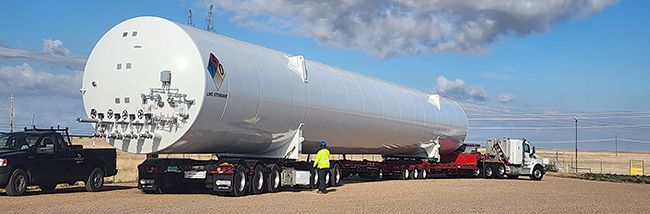
Buchanan has documented experience transporting large industrial tanks, including a 2024 project involving tanks approximately 100 feet long and more than 15 feet wide. Buchanan's Heavy Haul page also lists vessels and industrial storage tanks among the unique and specialized freight it supports. Shippers can view Buchanan's large tank transport video to see an example of the equipment preparation and loading considerations involved with long cylindrical freight.
Selecting Equipment for Boiler and Vessel Transport
There is no single trailer configuration for every pressure vessel or boiler. The correct equipment depends on the loaded height, total weight, length, width, support locations, loading method, ground clearance, and route.
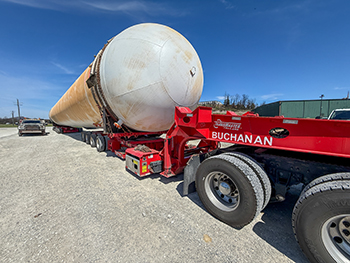
Buchanan's heavy haul equipment includes multi-axle configurations, extended trailers, step deck and lowboy equipment, 12- and 13-axle RGNs, steerable equipment, jeeps and stingers, and other specialized configurations. These options give the transportation team different ways to address deck height, weight distribution, long freight, and complex loading conditions.
For some oversize vessel transport projects, reducing deck height may be important because the vessel itself is tall. For heavier units, axle distribution may be the larger concern. Long vessels can create additional turning, rear swing, and site-access considerations.
The trailer should be selected around the actual shipment. Shippers can review Buchanan's Heavy Haul Trucking Services for equipment and project-planning information. Loads that are over-dimensional or unusually configured without requiring a major heavy haul setup may also fit Buchanan's Specialized Freight Transportation Services.
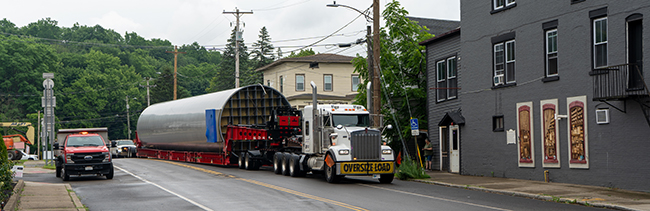
Loading, Supports, and Transportation Orientation
Loading a pressure vessel or boiler should be planned before the truck is dispatched. The carrier needs to understand how the equipment will be lifted, where it can be supported, and how it will sit on the trailer during transportation.
Important questions include:
- How will the vessel be loaded? Confirm whether cranes, rigging systems, jacking equipment, or another loading method will be used.
- Where can the equipment be supported? Provide manufacturer information, saddles, cribbing requirements, or approved support locations when applicable.
- What orientation is required? Confirm whether the vessel must move horizontally, vertically, or in another specified shipping position.
- What components can be removed? Platforms, ladders, nozzles, piping, or other attachments may affect width or height if they remain installed.
- What will happen at delivery? The unloading plan should match the trailer configuration, available lifting equipment, and receiving-site conditions.
Buchanan's Heavy Haul capabilities include crane and rigging coordination when a project requires those services to be integrated with the transportation plan.
Route Planning for Oversize Vessel Transport
Pressure vessel transportation can become a route-planning project when the loaded dimensions or weight exceed standard limits. Overall height, width, length, axle weights, turning requirements, and destination access can all affect the available route.
A route review may need to account for:
- Bridge and roadway restrictions
- Overhead clearances
- Construction zones
- Restricted travel periods
- State-specific permit conditions
- Escort or pilot-car requirements
- Turning space and intersection geometry
- Local access near the pickup or delivery site
The most direct highway route is not automatically the route that an oversized boiler or process vessel can use. Buchanan coordinates oversize and overweight permits, route planning, route surveys, and escort requirements when those steps apply to a heavy haul shipment.
For more detail on the planning process, read Buchanan's Heavy Haul Permits and Route Planning guide. Shippers can also review the U.S. Truck Weight Limits by State Reference Guide for general weight-limit information.
Origin and Destination Access Matter
A pressure vessel can fit the highway route and still create problems at the plant, fabrication shop, refinery, construction site, or other facility. Site access should be reviewed before the transportation schedule is finalized.
Useful site information includes:
- Gate and entrance dimensions
- Turning radius and available maneuvering room
- Overhead lines, piping, structures, or doors
- Pavement, gravel, or ground conditions
- Staging space for the truck and lifting equipment
- Facility operating hours and appointment restrictions
- Security or check-in requirements
- Construction activity that may affect access
Photos, site drawings, and recent access information can help identify issues that may not be obvious from the shipment dimensions alone.
Pressure Vessel Transport for Industrial Projects
Pressure vessels, boilers, and process vessels can be part of manufacturing, energy, food processing, chemical processing, power generation, and other industrial projects. Transportation may be required from a fabricator to a plant, between operating facilities, to a construction site, or as part of an equipment replacement or plant expansion.
The transportation schedule should be coordinated with the work around the shipment. Fabrication completion, inspections, crane availability, rigging crews, site construction, foundation readiness, and installation schedules can all affect the date when the equipment can actually move.
For project teams, the best transportation date is the date that matches real equipment readiness at the origin and actual unloading readiness at the destination.
Buchanan's Heavy Haul Experience With Large Vessels and Tanks
Buchanan Hauling & Rigging has operated as an asset-based trucking company since 1996. Its Heavy Haul Division handles oversized and overweight industrial freight and lists industrial storage tanks and vessels among the types of specialized freight it supports.
Buchanan has also documented several large tank transportation projects. In 2024, its Heavy Haul team moved long tanks from a fabricator to a customer plant. The published project details show the tanks at approximately 100 feet long, 15 feet 8 inches wide, and 14 feet 4 inches high, with an individual tank weight of 55,000 pounds. The overall permitted load was listed at 185,000 pounds and 191 feet long.
Another Buchanan project involved a 76-foot, 62,000-pound tank moving from Indianapolis, Indiana, to Florence, Kentucky. These tank projects are not presented as pressure-vessel projects, but they demonstrate Buchanan's documented experience planning transportation for large cylindrical industrial freight with significant length, width, and route requirements.
Shippers can view more examples through Buchanan at Work or learn more about the company on the About Buchanan page.
What to Provide for a Pressure Vessel Transport Quote
Accurate shipment information helps Buchanan evaluate equipment, routing, permit requirements, loading conditions, and the schedule before a transportation plan is finalized.
For a boiler, pressure vessel, or process vessel, provide as much of the following as possible:
- Equipment description and manufacturer
- Shipping length, width, and height
- Total shipping weight
- Center of gravity information when available
- Transportation orientation
- Support or saddle details
- Origin and destination addresses
- Requested pickup and delivery dates
- Loading and unloading methods
- Crane or rigging requirements
- Site-access conditions
- Photos and equipment drawings
- Information about removable attachments
- Known project or schedule restrictions
If dimensions or weights are still preliminary, identify them as estimates. Final equipment and permit planning should be based on confirmed shipment information.
Discuss a Vessel Move With Buchanan
Fabricators, manufacturers, contractors, plant managers, equipment suppliers, and project teams can send Buchanan the specifications for an upcoming pressure vessel, boiler, industrial tank, or process equipment move. Buchanan can review the freight dimensions, weight, loading conditions, site access, route considerations, and requested schedule to determine how its heavy haul or specialized transportation capabilities may fit the project.
Use Buchanan's Rate Quote page to submit shipment information. Include accurate dimensions, weight, origin, destination, loading and unloading details, requested dates, and any available drawings or photographs.
Have a boiler, pressure vessel, industrial vessel, or other oversized process equipment to move? Request a heavy haul quote from Buchanan Hauling & Rigging.